Workspace Planning
Desk, room and parking reservations show planned demand and help employees coordinate their day.

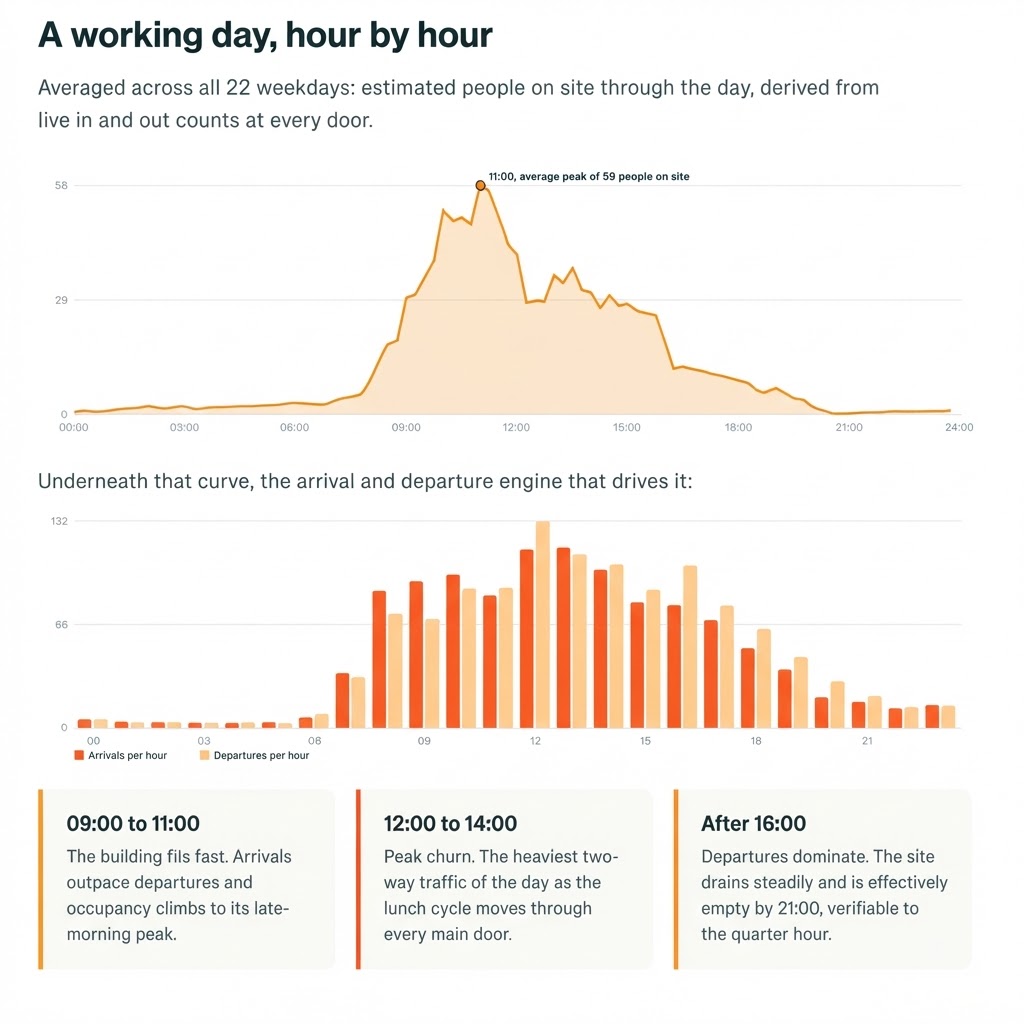
Occupancy Management measures how buildings, entrances and spaces are actually being used. Invisible Sun turns people counts, traffic and utilization data into a clearer picture of demand—so workplace teams can plan better and facility teams can respond to what is really happening.
Workspace Planning and Occupancy Management answer different questions. Ronspot helps manage the resources people intend to use. Invisible Sun Occupancy Management measures actual demand. Together, they create a stronger operating picture.
Desk, room and parking reservations show planned demand and help employees coordinate their day.
People counts, traffic and utilization show how buildings and spaces were actually used.
Actual demand can inform cleaning priorities, service levels, staffing and operational decisions.
The objective is not simply to collect sensor data. It is to translate actual space use into information facility teams can act on.
Measure people entering, leaving or moving through defined locations.
Understand how shared areas and operational spaces are actually used.
Convert occupancy conditions into operational events instead of asking teams to watch dashboards continuously.
Occupancy becomes most valuable when it informs what happens next.
Compare planned demand with actual use to understand where space is being used, where it is underused and how demand changes over time.
Use actual traffic and occupancy as a demand signal for cleaning. Higher-use spaces can be prioritized while lower-use spaces can be serviced according to actual need.
Badge swipe data shows building entry but not what happens inside—where people go, which spaces they use, or how long they stay. Occupancy Management uses sensors to track actual movement and space utilization throughout the building, giving facility teams a complete picture of demand, not just a front-door count.
Wi-Fi connection data estimates presence based on device connections, but not everyone connects, devices multi-connect, and the data doesn't show where people actually are within the building. Dedicated occupancy sensors measure physical presence directly—at entrances, in zones, and across spaces—providing more accurate and actionable utilization data.
Camera-based counting can work for entrance traffic but raises privacy concerns and can be affected by lighting, crowding, and camera placement. Invisible Sun uses sensor-based people counting that preserves privacy while still capturing accurate traffic, utilization, and threshold data across the facility.
Connect planned workplace demand, actual occupancy and service delivery in one facility operating strategy.